
It's Not the Splenda (Financial Guardrails for Founder Sanity)
When my health unraveled while scaling our business, I blamed everything — the coffee, the dairy, the Splenda — until my partner told me the hard truth. Here's how to stop lying to yourself and build the financial guardrails that protect your sanity.

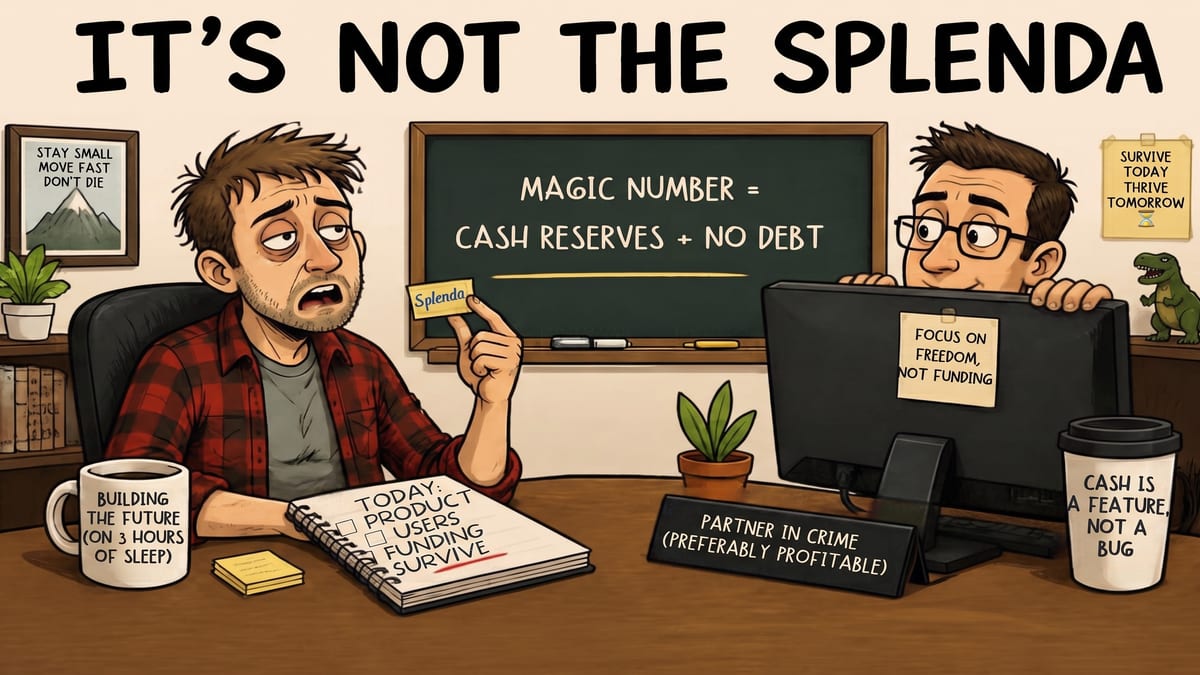
When Tom and I were trying to navigate a total mess of a business situation — juggling a vitamin company with a broken business model, dealing with bankruptcy attorneys, trying to get Canvas On Demand off the ground, and managing a handful of other failing incubations — my health unraveled at a breakneck pace.
My cheeks were sunken, my hair was thinning, I'd lost almost forty pounds, and I had zero energy because of brutal insomnia. I was constantly nauseous, feeling like I could blow chunks at any given second. My daily energy output dropped down to 80% of normal, which was 30% less than where I knew I should be.
I wasn't just sick; I was mad that I was sick.
I went through a gauntlet of medical tests. My wife Cheryl came with me to the doctor, and we sat there waiting for some grand diagnosis. The doctor looked at my lab results, looked us point blank in the eye, and said:
"Mr. and Mrs. Schmidt, I have no bad news. Your levels are fine. You don't have diabetes — or anything, for that matter. There's actually nothing wrong with you."
I couldn't believe it. I grasped at straws: "Not even high cholesterol? Hypertension? Low calcium?" Nothing. Healthy as a horse.
So I did what any rational, stubborn founder does: I started outsourcing my truth.
I convinced myself it was the coffee. I cut out caffeine and switched to decaf — nothing changed. Then I read some stuff online about artificial sweeteners and walked into Tom's office like a ragdoll. I sat down, weary and weak, and announced:
"Dude, I think it's the Splenda. That's what I'm cutting next. Good ol' fashioned sugar never hurt anyone, so I'm back on sugar and off Splenda."
Tom peered around his computer monitor, looked at me, and said: "Listen. It's not the Splenda."
Facing the Brutal Truth
Tom didn't sugarcoat it. He looked at me and laid it out flat:
"It's not the mold, or the dairy, or the gluten, or the Splenda, or the freeze-dried coffee, Joe. It's you. You're sick because of you. It's stress."
Coming from a Midwestern background, I bristled at the word stress. In my mind, stress was something for people in therapy or people living in California — not for guys like me. I tried to fight back, but Tom stopped me cold. He shared his own battle with severe IBS during his early days in New York — how he used to carry a backup pair of drawers in his pocket everywhere he went until his wife Mollie called bull and told him it wasn't the onions in his diet, but stress.
"You can't take all of this anxiety into your body and think it's not going to have an effect," Tom told me. "You have a choice. You can choose to live with the stress, or you can decide to change it. But get honest with yourself. It's not the Splenda."
Sitting there in silence, looking at the mountain of uncertainty in front of us — a new baby at home, a new house, failing businesses, and a totally unclear future — I realized he was right. If I didn't stop wasting away into an ashy pile of Schmidt, I was going to collapse.
The Remedy: Calculating Your Magic Number
Once I accepted the brutal truth, Tom and I sat down with a flashlight to look straight into the dark corners of our anxiety. I described my brain as a wall of light switches — I could handle a lot of them flicking off, but once there was one switch too many, it was lights out.
When we audited what was actually tripping those switches, the biggest culprit was our financial chaos. We were running on fumes, living month-to-month, and carrying debt.
So we created a tangible, non-negotiable guardrail: The Magic Number.
We sat down with our bookkeeper, Shannon, and established an exact target for cash-on-hand. We calculated the exact dollar amount needed in our bank account so that if every revenue stream imploded, our website went down, and orders completely dried up, we could still pay off all outstanding debt, make payroll, and keep operating smoothly for two full months.
We also built an aggressive plan to attack our debt. Debt was my personal kryptonite — carrying it added a weight to my chest that directly triggered my physical sickness.
Over the next six months, we adjusted our business weekly based on that Magic Number. We sacrificed short-term vanity spending to build our cash surplus and wipe out debt. And the day Shannon walked into my office and told us, "You just hit your Magic Number," the physical weight lifted off my shoulders. We had built a financial buffer that protected my sanity.
How to Stop Blaming the "Splenda" in Your Business
If you're physically, mentally, or emotionally burning out right now, stop looking for minor external inconveniences to blame. Use these steps to audit your own reality:
Find a Brutality Buddy. Get an honest partner, peer, or mentor who knows you well enough to call BULL when you're lying to yourself about your stress.
Identify Your Kryptonite. What single operational or financial trigger causes your highest anxiety? For me, it was debt and low cash reserves. Establish a strict rule to limit or eliminate it.
Establish Your Magic Number. Calculate the exact amount of cash on hand you need to cover expenses, pay off debt, and sleep soundly at night.
Ruthlessly Simplify. Manage your business to that Magic Number as if it were your sole bottom line — because for your health, it is.
The EntreManure bottom line: even EntreManures have their limits. Know them, plan for them, stop blaming external distractions, and build financial guardrails that serve your life.
Explore Topics
Written by
Josef Schmidt
Content creator and writer sharing insights and stories.